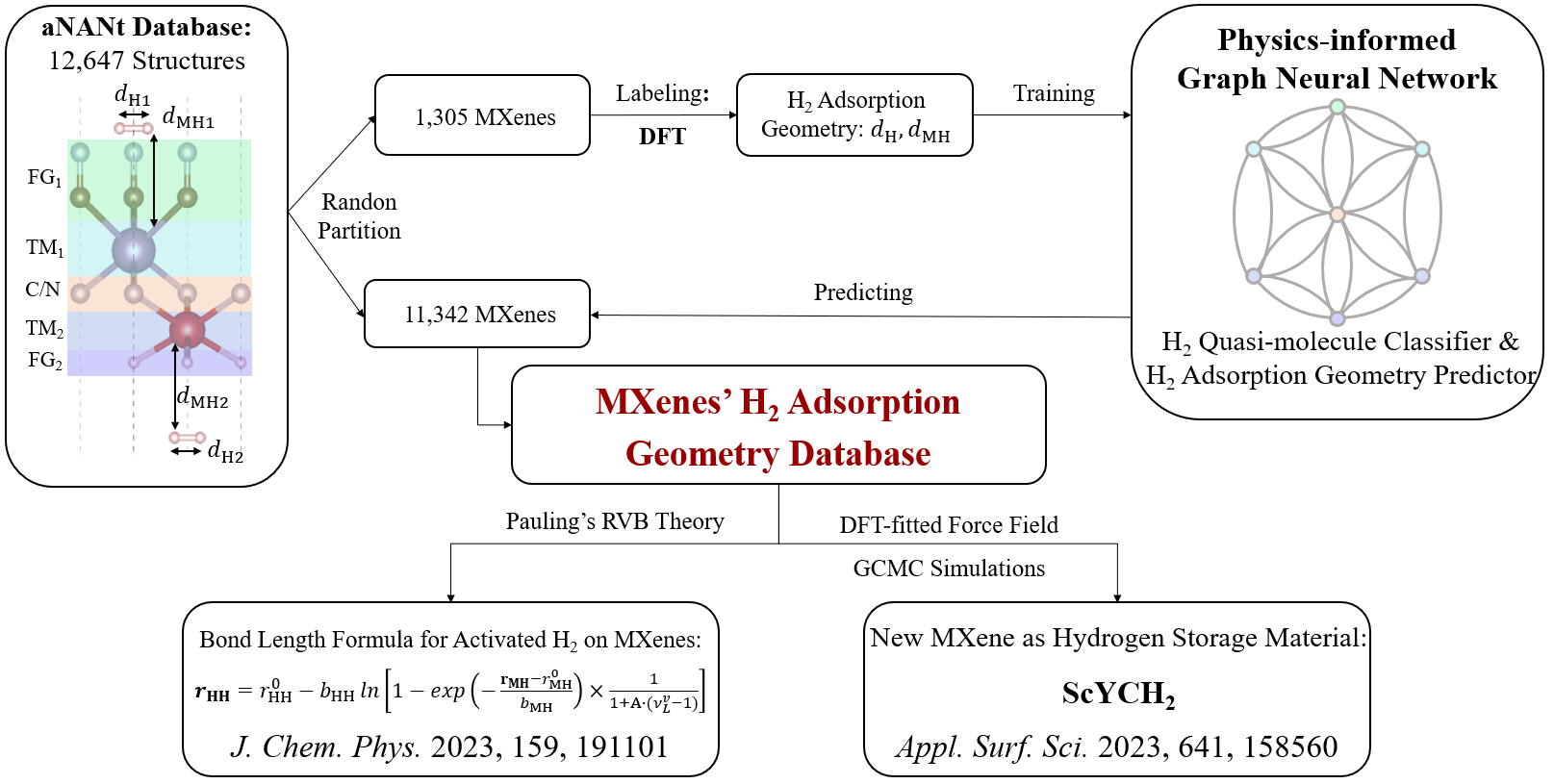
MXene’s H₂ Adsorption Geometry Database is an open resource constructed to accelerate the discovery of MXene-based hydrogen-storage materials. The repository focuses on TM₁–TM₂–C/N–FG₁–FG₂ MXenes (TM = early transition metal, C/N = carbon or nitrogen and FG = functional group) and provides quantitative structural labels that describe how a hydrogen molecule interacts with each surface.
1. Construction by high-throughput DFT
Starting from the aNANt MXene database [Chem. Mater., 2018, 30(12), 4031] (23,870 compositions), we selected 12,647 low-mass candidates. For every TM site a single H₂ was placed (two molecules for each structure), followed by full relaxation of the molecules for 1,305 random selected structures. From the converged structures, four geometric descriptors were extracted: d H1, d H2 – the two H–H bond lengths; d MH1, d MH2 – the distances between each H₂ center-of-mass and the nearest TM atom. These four numbers faithfully capture whether H₂ remains quasi-molecular (through charge polarization or Kubas-type activation) or dissociates into atoms.
2. Labelling & machine-learning models
The raw DFT set (1,305 structures) was used to train two physics-informed ALIGNN models:
- Quasi-molecule classifier: a classifier that decides if an adsorbed H₂ is molecular (d H ≤ 0.9 Å) or dissociated (d H > 0.9 Å). The precision of this model is 0.938 (for upper H 2) and 0.957 (for lower H 2).
- Adsorption-geometry predictor: a multi-output regression ALIGNN that simultaneously predicts d H and d MH for each H₂. A bond-order loss term was added to transform our model into a physics-informed version, reducing the mean-absolute error to 0.003 Å for d H and 0.166 Å for d MH.
The well-trained model was applied to the remaining 11,342 MXenes, delivering a total of 9 883 fully labelled quasi-molecular adsorption geometries shown in this website.
3. Scientific outputs enabled by the database
- Bond length formula for activated H 2 on MXenes [J. Chem. Phys., 2023, 159, 191101]: by statistically fitting the entire dataset we derived an equation based on Pauling’s Resonating Valence Bond (RVB) Theory that quantitatively links the activated H–H bond length to the adsorption distance, which is decided by the TM valence electron count and its ligancy. The formula correctly reproduces the weakening of activation when TM is six-fold coordinated, and explains why early TMs with fewer d-electrons stretch H₂ more efficiently.
- Materials discovery [Appl. Surf. Sci., 2023, 641, 158560]: screening the predicted geometries for d H
- 0.755 Å and light mass singled out 46 high-activation candidates; ScYCH₂ emerged as the best compromise between gravimetric capacity and operating conditions. Grand canonical Monte Carlo simulations using an DFT-fitted Morse potential confirmed an excess uptake of 5.7 wt % at 230 K and 100 bar.
Reference
- J. Cheng, T. Li, Y. Wang, A. H. Ati, Q. Sun*, High-throughput screening of MXenes for hydrogen storage via graph neural network. Appl. Surf. Sci. 2023, 641:158560
- J. Cheng, T. Li, Y. Wang, A.H. Ati, Q. Sun*, The relationship between activated H2 bond length and adsorption distance on MXenes identified with graph neural network and resonating valence bond theory (front cover, featured article), J. Chem. Phys. 2023, 159:191101
Lorem ipsum dolor sit amet, at mei dolore tritani repudiandae. In his nemore temporibus consequuntur, vim ad prima vivendum consetetur. Viderer feugiat at pro, mea aperiam